The choice of wardrobe door is among the most consequential decisions in any bedroom interior. The hinged vs sliding wardrobe doors debate is not simply a matter of preference. It determines how the space functions, how it reads as a designed environment, and the standard of quality the room sets for itself. There is no universal answer. The right system matches precisely with your room’s dimensions, the direction of your interior design, and the standard of living you have set for your home.
Understanding the Two Wardrobe Door Styles
Both door types can deliver comparable storage depth and a sophisticated finish. The distinction lies in their mechanism, their spatial requirements, and the design language each brings to the room.
A Close Look at Hinged Wardrobe Doors
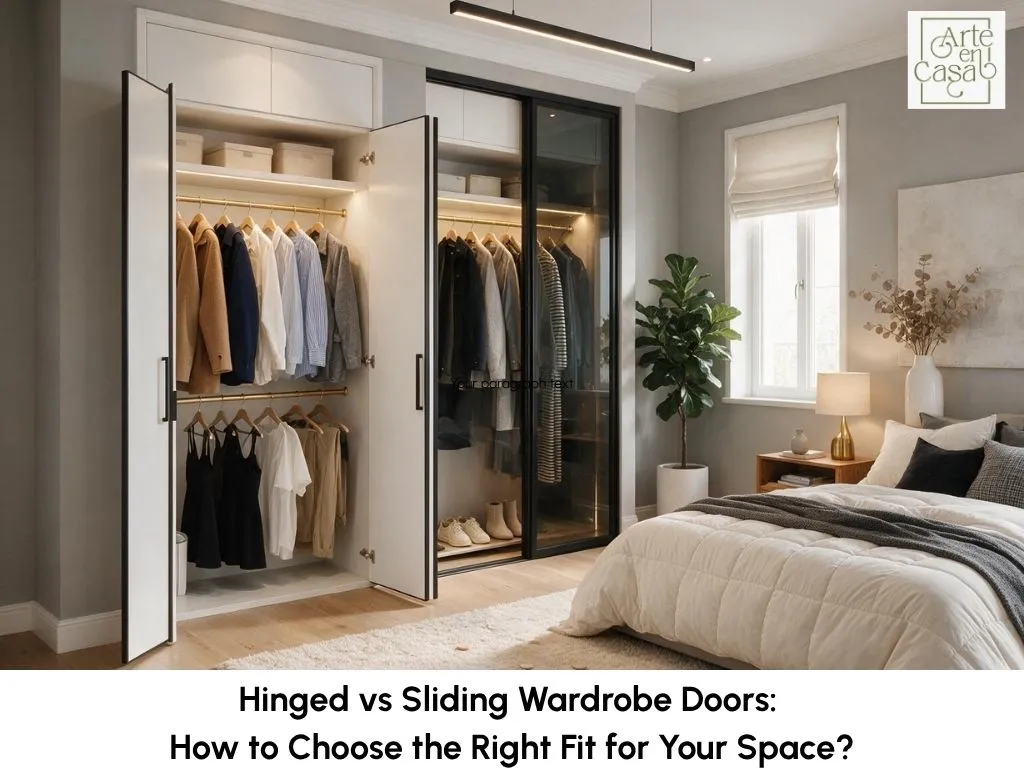
Hinged wardrobe doors are a timeless choice that open outward to give you complete access to the wardrobe interior. With every section visible at once, they make organising and accessing your belongings effortless.
Where Hinged Wardrobe Doors Work Best
Hinged wardrobe doors are an excellent choice for:
- Master bedrooms with ample floor space
- Walk-in wardrobes and dressing rooms
- Homes with classic, transitional, or contemporary interiors
- Homeowners who prefer full access to the wardrobe at once
What Makes Hinged Wardrobe Doors a Popular Choice?
They offer practical features that enhance everyday use, including:
- Complete visibility of the wardrobe interior
- Space for mirrors, hooks, organisers, and accessory racks behind the doors
- A wide choice of finishes, including wood veneers, painted panels, fluted designs, and glass
- A timeless look that complements both traditional and modern homes
Understanding Sliding Wardrobe Doors
Sliding wardrobe doors glide smoothly along concealed tracks, allowing the wardrobe to open without requiring additional floor space. Their streamlined operation makes them a popular choice for modern homes where space and clean design go hand in hand.
Where Sliding Wardrobe Doors Work Best
Sliding wardrobe doors are ideal for:
- Compact bedrooms and apartments
- Contemporary and minimalist interiors
- Rooms where saving floor space is a priority
- Full-height wardrobes that create a seamless look
What Makes Sliding Wardrobe Doors a Popular Choice?
Premium sliding wardrobe doors combine style with functionality through features such as:
- Space-saving horizontal operation
- Soft-close mechanisms for smooth, quiet movement
- Full-height mirror or glass panels that enhance the sense of space
- Sleek, uninterrupted designs that create a clean and sophisticated aesthetic
The Differences That Matter in Hinged vs Sliding Wardrobe Doors
The hinged vs sliding wardrobe doors decision becomes clear when examined across four factors: how each door interacts with the room’s space, how it is used each day, the aesthetic direction it carries, and its long-term performance. Here is a direct comparison before each factor is explored in depth.
At a glance:
- Space: Sliding doors need zero floor clearance to open; hinged doors require approximately 90cm of free space in front.
- Access: Hinged doors open fully for a complete view of all contents simultaneously; sliding doors reveal one section at a time.
- Aesthetics: Sliding doors carry a contemporary, architectural quality; hinged doors span a broader stylistic range.
- Mirrors: Sliding systems are structurally better suited to full-length mirror panels due to horizontal weight distribution.
- Irregular layouts: Hinged doors adapt readily to corners, angled ceilings, and irregular walls; sliding doors require a straight wall run.
- Shared use: Hinged doors allow two people to access different sections of the wardrobe at the same time.
Hinged vs Sliding Wardrobe Doors: At a Glance
| Hinged Doors | Sliding Doors | |
| Floor clearance required | ~90cm in front | None |
| Closed-state depth | ~60 to 62cm | ~65 to 66cm |
| Best room type | Larger rooms, irregular layouts | Compact rooms, rectangular plans |
| Full simultaneous access | Yes: all sections open at once | No: one section at a time |
| Shared wardrobe use | Both sides open simultaneously | One section open at a time |
| Aesthetic direction | Classical to contemporary | Strongly contemporary |
| Full-length mirror panels | Limited by hinge weight strain | Ideal: horizontal weight distribution |
| Corner or angled ceiling fit | Yes | No |
| Maintenance | Low: hinge checks only | Moderate: periodic track cleaning |
| Longevity factor | Hinge hardware quality | Track and roller quality |
Pros and Cons of Hinged vs Sliding Wardrobe Doors
The debate around hinged vs sliding wardrobe doors is less about which is better and more about which suits your space. Each option brings unique benefits, and the ideal choice is shaped by your lifestyle, room layout, and interior aesthetic.
Pros Hinged Wardrobe Doors
Full and immediate access to all contents
Hinged doors open completely, giving a total, unobstructed view of every section simultaneously. Selecting from a large wardrobe is faster and more intuitive when everything is visible at once, without the need to slide one panel past another.
Adaptability to irregular spaces
Hinged systems can be specified for corner positions, angled ceilings, narrow alcoves, and rooms with sloped rooflines. This makes them the more versatile system for rooms that deviate from a standard rectangular plan.
Broader stylistic range
From classically detailed finishes to clean contemporary profiles, hinged wardrobes span the full breadth of interior design directions. The handle material and profile add a further layer of design expression that is not available on handleless sliding systems.
Lower maintenance by design
With fewer moving components, hinged doors require minimal upkeep over their lifetime. A loose hinge can be tightened or replaced with no specialist tools and without disturbing the wardrobe structure.
Interior door storage
The inner face of each hinged door can carry hooks, organiser pockets, belts, and accessories, creating an additional layer of artisanal storage within the door panel itself.
Cons Hinged Wardrobe Doors
Floor clearance requirement
Hinged doors require a minimum of approximately 90cm of unobstructed floor space in front of the wardrobe to swing open fully. In compact bedrooms, this constraint affects furniture placement and the overall spatial flow of the room.
Panel width limitation
Individual hinged panels are typically kept below 600mm in width to protect the hinge from cumulative daily strain. Wider wardrobes therefore require more panels and more hinges to span the same opening, which can affect the visual rhythm of the wardrobe face.
Pros Sliding Wardrobe Doors
No floor clearance required
Sliding doors travel horizontally along a track and require zero clearance in front of the wardrobe. This makes them the considered choice for compact rooms, wardrobes positioned at the foot of the bed, and any layout where floor space is at a premium.
Contemporary architectural quality
Large, uninterrupted panels in frameless glass, lacquered finishes, or mirrored surfaces bring a distinctly modern, architectural quality to the bedroom. The door functions as a design surface, not simply a functional closure.
Structurally suited to full-length mirror panels
The horizontal track distributes the weight of full-length mirror panels evenly across the door. Sliding systems are the preferred specification for large mirror doors, and they eliminate the need for a separate dressing mirror within the room.
Suited to full-height installations
Sliding systems extend cleanly from floor to ceiling, maximising storage height and producing a fitted, architectural finish that integrates with the room’s proportions rather than sitting within them.
Greater panel width per door
Because the weight of a sliding panel is distributed along the track rather than supported on a single hinge side, individual panels can be made significantly wider than hinged panels. This reduces the number of visible joins across the wardrobe face.
Cons Sliding Wardrobe Doors
Access limited to one section at a time
One panel always covers part of the wardrobe interior while the adjacent section is open. Full, simultaneous access to all contents is not possible, which requires more considered organisation of wardrobe contents to compensate.
Track maintenance
The track channel requires periodic cleaning to prevent dust and debris from affecting the smoothness of door movement. Premium hardware reduces the frequency considerably, but it remains an ongoing maintenance consideration that hinged systems do not share.
Key Questions to Ask Before Choosing Hinged or Sliding Wardrobe Doors
The sliding door vs hinged door wardrobe decision becomes clear when approached systematically rather than by preference. Three areas consistently determine the right outcome. These are the spatial constraints of the room, the daily demands of those using the wardrobe, and the aesthetic direction of the interior. Addressing each in sequence brings clarity before any material or mechanism is selected.
Room and Spatial Layout
The physical configuration of your room is often the most decisive factor in the entire decision. A room that cannot accommodate the floor clearance a hinged door requires has already resolved the question, regardless of aesthetic preference. Similarly, corner positions, angled ceilings, and narrow alcoves have their own implications that must be assessed before any other consideration.
- Hinged systems suit corners, sloped ceilings, and irregular layouts.
- Sliding systems work best on long, straight walls.
Use and Lifestyle
People who share a wardrobe and dress simultaneously will find the two systems deliver very different experiences in practice. A single user with a methodical routine faces a different set of priorities. Maintenance expectations are equally relevant and deserve honest consideration alongside aesthetics.
- Hinged wardrobes provide full access to the entire interior.
- They are more convenient when two people share the wardrobe.
- Sliding wardrobes open one section at a time.
- Hinged systems need minimal maintenance, while sliding tracks require occasional cleaning.
- Only occasional hinge checks and are lower maintenance by design.
Design and Finish Direction
When the room’s aesthetic is clearly contemporary and calls for uninterrupted panel surfaces, the sliding configuration presents itself as the natural specification. A room that draws on multiple design eras, or where bespoke hardware is part of the design language, is typically better served by a hinged system. Clients working with an interior architect will often find the door type confirmed at this stage, before spatial measurements need to be consulted.
- Sliding wardrobes complement modern, minimalist interiors.
- Hinged wardrobes suit both classic and contemporary styles.
- Sliding systems are ideal for full-height mirror and glass panels.
- Hinged wardrobes offer greater flexibility in door profiles and hardware.
How to Choose Between Sliding vs Hinged Wardrobe Doors for Your Space?
The right door type becomes clear when the decision is grounded in the specific character of your room and how you use it. The scenarios below offer a direct guide.
Choose sliding wardrobe doors if:
- Your bedroom is compact, or the wardrobe sits at the foot of the bed
- You want a full-height, floor-to-ceiling installation with a clean architectural finish
- Mirrored or glass panels are central to the design direction of the room
- The layout follows a rectangular plan with sufficient wall run on either side
Choose hinged wardrobe doors if:
- Your bedroom accommodates the door swing with comfort
- The wardrobe needs to fit a corner, an angled ceiling, or an irregular wall
- Two people share the wardrobe and dress at the same time
- The interior design calls for a stylistic range wider than contemporary alone
When the room presents competing criteria, a bespoke approach resolves what a standard solution cannot. A system designed specifically for your space will always outperform one adapted from a standard configuration.
Bespoke Wardrobe Systems Curated by Arte En Casa
For those comparing hinged vs sliding wardrobe doors, the right choice comes down to your space, lifestyle, and design preferences. At Arte En Casa, both systems are crafted to the same exacting standards of Italian design, premium materials, and bespoke craftsmanship.
Arte En Casa draws on the manufacturing excellence of Veneto, our parent manufacturer. The range includes sliding collections such as HELIOS, CRONOS, ZEUS, and ARES, alongside a refined openable wardrobe range for those who prefer full spatial access at a glance. Design consultation takes place in person at our Lower Parel showroom in Mumbai, where both systems, materials, and finishes can be experienced firsthand.
Making the Final Decision
The sliding vs hinged wardrobe doors debate reflects a more fundamental question: what standard of precision, craft, and design does your home demand? Both systems, when specified and installed with the rigour they deserve, perform with distinction for decades. The right choice is the one designed for your specific room, your specific aesthetic direction, and your specific standard of living. That level of considered specification is what produces elevated interiors that endure.
FAQs
Q1: In the hinged vs sliding wardrobe doors comparison, which is better for a small bedroom?
Sliding wardrobe doors are generally the better choice for small bedrooms because they do not require extra floor space to open. However, hinged wardrobe doors can also work well if there is enough clearance in front of the wardrobe.
Q2: Are sliding wardrobe doors more difficult to maintain than hinged wardrobe doors?
Yes, sliding wardrobe doors need occasional track cleaning to ensure smooth movement. Hinged wardrobe doors are typically lower maintenance and only require periodic hinge checks.
Q3: Which offers better access to wardrobe contents, a sliding door vs hinged door wardrobe?
In a sliding door vs hinged door wardrobe comparison, hinged wardrobes provide full access to the entire interior at once. Sliding wardrobes allow access to one section at a time.
Q4: Can sliding vs hinged wardrobe doors both support full-length mirrors?
Yes, both can include mirrors. However, in the sliding vs hinged wardrobe doors comparison, sliding wardrobes are generally better suited for full-length mirror panels.
Q5: Do hinged vs sliding wardrobe doors differ in how they fit awkward or corner spaces?
Yes. In the hinged vs sliding wardrobe doors comparison, hinged wardrobes are more adaptable for corners, sloped ceilings, and irregular layouts, while sliding wardrobes work best on straight walls.
Q6: Which lasts longer, sliding vs hinged wardrobe doors?
Both sliding vs hinged wardrobe doors can last for many years when built with quality materials and hardware. Regular maintenance helps ensure smooth performance and long-term durability.