
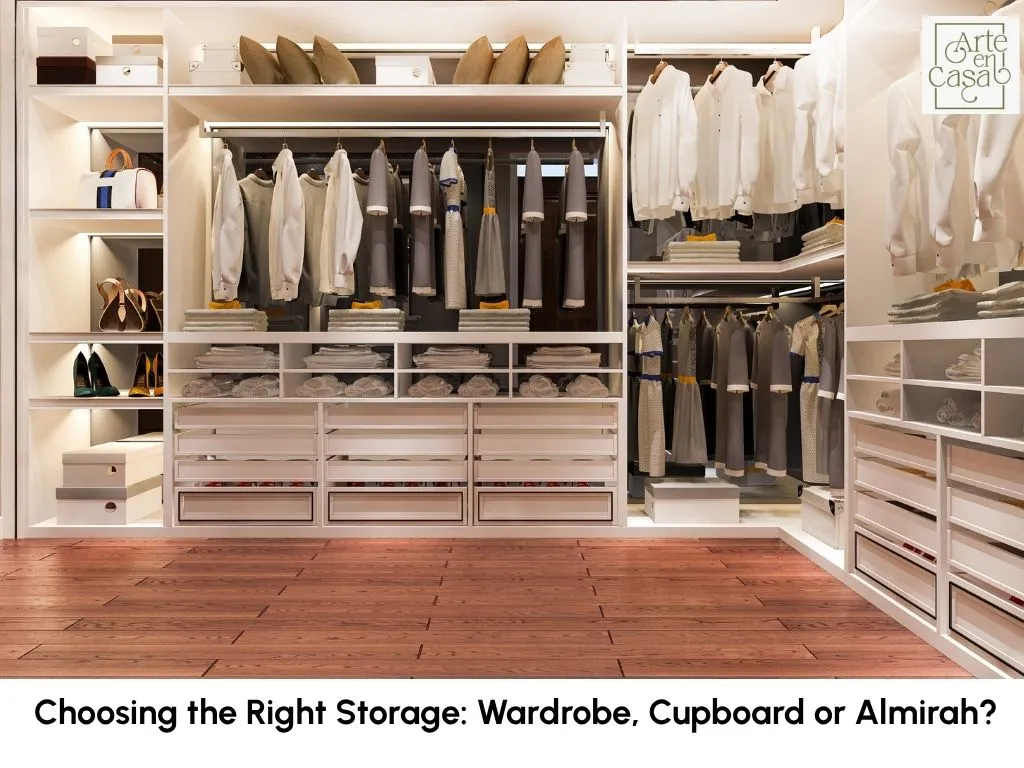
The same storage furniture often carries three different names in homes: wardrobe, cupboard, and almirah. A wardrobe to one person is a cupboard to another and an almirah to a third. The disagreement is almost never about the furniture itself. It is about language, memory and the quiet habits of a room. Understanding the difference between wardrobe, cupboard and almirah has less to do with dictionaries. It has more to do with how you want a space to work and feel. This guide draws the lines clearly, so the storage you choose belongs to your home rather than fights it.
Understanding the Three Storage Types
Before you can compare them, it helps to meet each one on its own terms. The three overlap in daily speech, which is exactly where the confusion begins. Each carries its own history, its own character and its own reason for being in a home.
What Is a Cupboard?
The cupboard is the oldest and most forgiving of the three. Its name reaches back to a medieval cup board, a plain shelf where cups and dishes once sat. That humble beginning still shapes what a cupboard is today, a piece that stores almost anything, almost anywhere. You will find it in kitchens holding provisions, in hallways holding linen, in bedrooms holding the small chaos of everyday life. Sizes run from a compact two door unit to a full height piece that reaches the ceiling. Some wear glass fronts and invite you to display. Others stay closed and keep the room calm.
What Is a Wardrobe?
The wardrobe is the one built entirely around you, or rather around your clothes. Inside, hanging rails, shelves and drawers hold garments, shoes and the pieces you reach for each morning. It belongs to the bedroom, where the first and last moments of a day are spent. Many carry a mirror on the door, so the wardrobe dresses the room as much as it dresses you. Freestanding or fitted, with sliding or hinged doors, it bends to the shape of the space it lives in.
Popular Wardrobe Styles
Style is where a wardrobe meets the character of the room. A hinged wardrobe opens fully to a classic, generous look, ideal where space is easy. A sliding wardrobe keeps the floor clear and feels clean and contemporary. A walk in wardrobe becomes a small dressing room, a private luxury for those with the space to give. A mirrored front brings light into a bedroom and doubles as a full length mirror.
What Is an Almirah?
The almirah carries the most memory of the three. Its name travelled into India through Portuguese, from the Latin armarium, a word for a chest or store. For generations it has stood in the corner of Indian homes, often in steel, usually with a lock and a single small key. Behind that door, families have kept saris, documents, jewellery and the things that matter most. It is storage, certainly, yet it is also a keeper of what a household holds dear.
Difference Between Wardrobe and Cupboard
Ask which is which, and most people pause, because a wardrobe and a cupboard can look almost identical from the outside. The difference between wardrobe and cupboard lives on the inside, in how each is arranged and what it is asked to hold. One is devoted entirely to clothing. The other turns its hand to anything.
Seen side by side, the distinction becomes clear:
- Purpose: A wardrobe keeps clothes and accessories, while a cupboard holds mixed items across the home.
- Interior: Wardrobes bring together rails, shelves and drawers, while cupboards lean on shelves alone.
- Placement: A wardrobe belongs in the bedroom, while a cupboard settles into kitchens, hallways and living rooms alike.
- Scale: Wardrobes tend to be larger, while a cupboard can shrink to fit a tight corner.
There lies the real difference between a wardrobe and a cupboard. One is made for your clothes. The other is made for your life.
Difference Between Cupboard and Almirah
Set a cupboard beside an almirah and the contrast becomes one of temperament. A cupboard is easygoing, often wooden, shelved and open to whatever you place inside. An almirah is guarded, usually steel, standing on its own with a lock to match.
The difference between cupboard and almirah is really a difference of trust. A cupboard organises the everyday, the things you reach for without a thought. An almirah protects the treasured, the things you would never want to lose. Even their finishes tell the story. One is dressed to suit a room, the other built plainly to endure.
Difference Between Almirah and Wardrobe
Here, the two feel like different eras of the same idea. An almirah is heritage, freestanding and lockable, made to be carried from one home to the next. A wardrobe is the present, fitted to a room and planned around a particular life.
The difference between almirah and wardrobe often comes down to a single question. Do you want storage that travels with you, or storage that belongs to a room? An almirah is handed down, moved and remembered. A wardrobe is designed to hold one chapter of a home beautifully.
Wardrobe vs Cupboard vs Closet
For a moment of clarity, here is how the three compare across what matters most when you choose.
| Feature | Wardrobe | Cupboard | Almirah |
|---|---|---|---|
| Main use | Clothing and accessories | Mixed household items | Clothes, documents and valuables |
| Interior | Rails, shelves and drawers | Shelves and compartments | Shelves, sometimes a rail |
| Placement | Bedroom or dressing room | Any room in the home | Freestanding and movable |
| Material | Wood, board, glass or metal | Wood, metal, glass or laminate | Steel or solid wood |
| Character | Tailored and modern | Versatile and practical | Sturdy and secure |
| Best for | A dedicated bedroom clothing store | Flexible storage in any room | Portable, secure storage |
How to Choose the Right Storage for Your Space?
The right choice is rarely about the label on the piece. It is about the way you live inside your rooms. Before you decide, weigh three simple things. Think about what you need to keep, how often you reach for it, and how much room you can spare.
Let these guide you:
- Space: Measure the room first. A generous wardrobe suits a bedroom, while a slim cupboard or almirah eases into a tight corner.
- Purpose: Choose a wardrobe for clothing, a cupboard for mixed storage, and an almirah for storage that stays secure and can still move.
- Material: Match wood, glass or steel to your interiors, and to the humidity your home meets through the year.
- Character: Choose a finish that settles into the room in harmony, rather than one that competes for attention.
For a bedroom you want to feel calm and considered, a well planned wardrobe almost always earns its place.
Bespoke Storage, Designed by Arte En Casa
At Arte En Casa, a wardrobe is treated as architecture, never an afterthought. Each sliding system and bespoke wardrobe is shaped with Italian craftsmanship, refined materials and a precision that off the shelf pieces can never quite reach. Because a piece this considered deserves to be seen and touched, it is refined in person at our showroom. The design never happens through a template online. Book a showroom visit, and let a wardrobe become part of how your home feels, not merely where things are kept.
Conclusion
Choosing between these three is rarely a matter of which is best. It is a matter of which one belongs in your home and the way you live in it. A cupboard offers easy, everyday flexibility. The almirah brings strength and a place for what you treasure. A wardrobe offers a considered home for your clothes. Once you know what you keep and how much room you hold, the right piece almost chooses itself. When that piece is a wardrobe worth building around, book a showroom visit with Arte En Casa and design it, in person, to belong.
Frequently Asked Questions
1. What is the difference between a wardrobe and a cupboard?
The difference between a wardrobe and a cupboard is mostly a matter of purpose. A wardrobe is made for clothing, with hanging rails, shelves and drawers, and lives in the bedroom. A cupboard is a general storage unit for mixed items and settles almost anywhere in the home.
2. What is the difference between a cupboard and an almirah?
The difference between a cupboard and an almirah is one of build and intent. A cupboard is usually wooden and shelved, open to varied storage, and may be fixed or free. An almirah is sturdier, often steel, always freestanding, and frequently locked to keep valuables safe.
3. What is the difference between an almirah and a wardrobe?
The difference between an almirah and a wardrobe comes down to heritage and design. An almirah is a freestanding, movable unit you can carry between homes. A wardrobe is planned for a particular room, with fitted interiors tailored to clothing.
4. In the wardrobe vs cupboard vs closet comparison, which suits a bedroom?
In the wardrobe vs cupboard vs closet comparison, the answer depends on your room. A closet is built into the wall and works when the architecture allows it. A wardrobe suits most bedrooms as elegant, flexible clothing storage, while a cupboard is better kept for mixed items elsewhere.
5. Which is better, a wardrobe or an almirah?
Neither is better outright, as it depends on what you value. If you want secure storage that can move with you, an almirah is the practical choice. If you want tailored, elegant clothing storage for a bedroom, a wardrobe wins. That is the difference between almirah and wardrobe most homes come to feel.